Bottom Line
The CRS-35 mission provides a dual benefit: it strengthens the International Space Station’s power infrastructure while delivering a suite of experiments designed to solve terrestrial health challenges and prepare humans for long-duration missions to the Moon and Mars.
The Verified Development
NASA has launched its 35th commercial resupply mission (CRS-35) via a SpaceX Falcon 9 rocket from Cape Canaveral Space Force Station. The mission carries more than 6,300 pounds of supplies and hardware destined for the International Space Station (ISS).
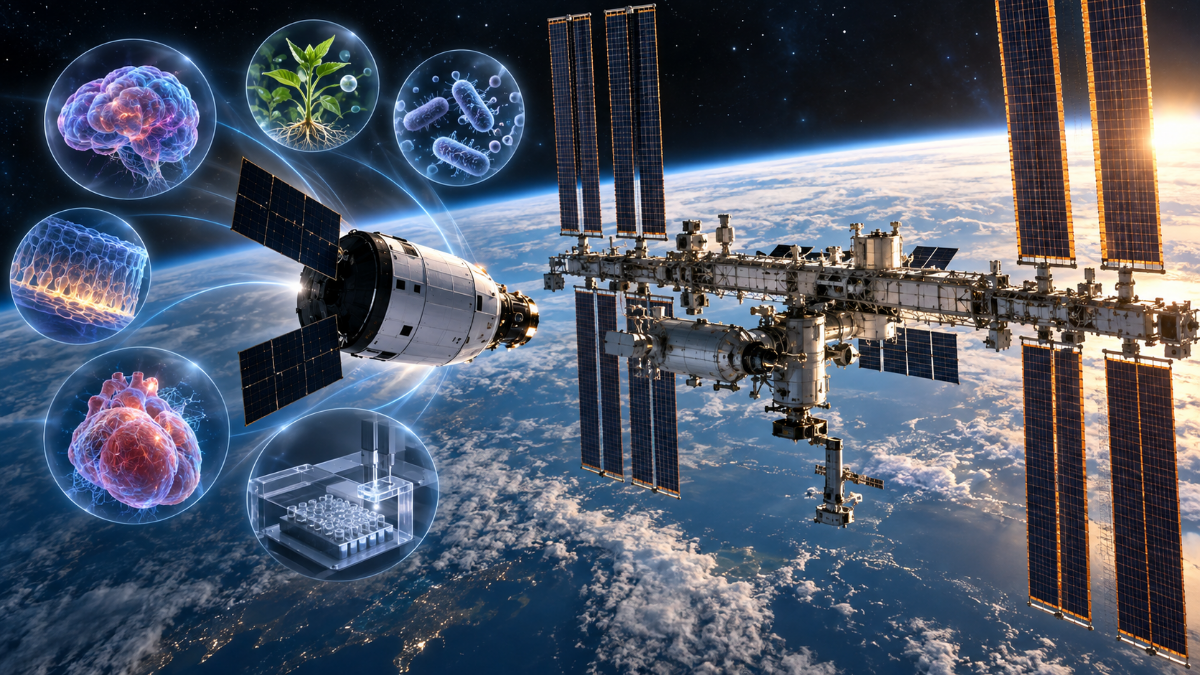
The SpaceX Dragon spacecraft is scheduled to autonomously dock with the space station’s Harmony module on Thursday, Oct. 15, at 11 a.m. This mission serves as a critical logistics link, delivering new scientific experiments, cargo, and the final pair of International Space Station Roll-Out Solar Arrays.
Advancing Human and Plant Health Research
The CRS-35 mission is specifically tasked with advancing research that benefits life on Earth and prepares for future deep-space exploration. Key investigations include:
- Human Brain Modeling: The mission carries lab-grown models of the human brain to the orbiting laboratory for five weeks. Researchers will compare these models to those kept on Earth to determine how short spaceflights affect the human brain at a cellular level, specifically looking at responses to stress.
- Space Agriculture: A crop disease study will test whether fungus-induced diseases develop faster or more severely in microgravity. These findings aim to guide plant breeding on Earth for disease-resistant crops and improve future space agriculture systems.
- Antibiotic Resistance: The mission includes a fourth and final planned stay to study how antibiotic-resistant bacteria survive and evolve in microgravity. Astronauts will sample surfaces throughout the station to monitor for drug-resistant organisms, providing insights into how “superbugs” develop from antibiotic overuse on Earth.\n* Biotechnology: The cargo includes hardware to manufacture artificial retinas in microgravity and 3D heart tissue models to advance large-scale drug testing.
Infrastructure and Logistics
Beyond biological research, the mission delivers essential infrastructure for the station’s longevity:
- Power Augmentation: The final pair of solar arrays will complete the space station’s power system augmentation. These arrays will boost available electricity for research, operations, and the station’s eventual safe, controlled deorbit.
- Rapid Science Capabilities: The spacecraft carries a compact microplate reader. This device allows scientists to analyze samples—such as antibodies, antigens, and proteins—directly aboard the space station, providing faster data without waiting for samples to return to Earth.
Verified Source Evidence
NASA’s SpaceX 35th commercial resupply mission lifted off at 6:33 a.m.
Source: NASA — NASA Science, Cargo Launch on 35th SpaceX Resupply Mission to Station – NASA (.gov).
Source Licensing
- Source policy: NASA-MEDIA-USAGE-GUIDELINES (https://www.nasa.gov/nasa-brand-center/images-and-media/). NASA source material was used. The generated output is not attributed to the source organization. AI product attribution: Aurora AI. NASA review or permission is not implied.
- Source policy: NASA-MEDIA-USAGE-GUIDELINES (https://www.nasa.gov/nasa-brand-center/images-and-media/). NASA source material was used. The generated output is not attributed to the source organization. AI product attribution: Aurora AI. NASA review or permission is not implied.
Sources
1 independent organization · 2 source document. Links open the original material.