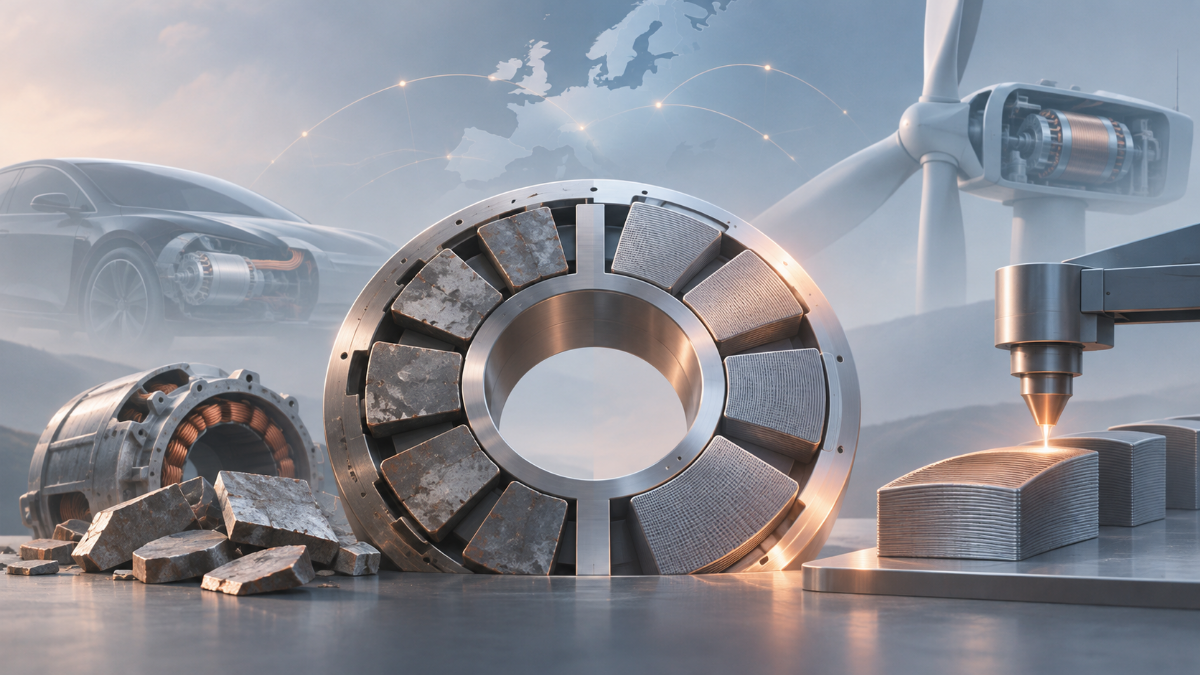
Europe is intensifying efforts to reduce its dependence on rare earth elements, which are essential for the production of permanent magnets used in electric car traction motors and wind turbine generators. Currently, China mines 60% of the world’s rare earths used in magnets, refines 91%, and manufactures 94% of permanent magnets, according to the International Energy Agency.
Bottom Line
By integrating recycled materials into high-performance applications and developing 3D-printed AlNiCo alternatives, Europe seeks to build a more resilient supply chain for the technologies driving the energy transition.
Recycling and Advanced Manufacturing
The EU-funded MAGELLAN initiative, a 14-partner research project spanning eight countries, is rethinking the magnet life cycle from design to dismantling. Researchers have tested extracting magnets from electric bikes, scooters, and end-of-life cars. While recycling may initially cost more than using newly mined materials, experts suggest it offers a strategic payoff by strengthening the supply chain.
The MAGELLAN team has already produced high-performance magnets containing 25% recycled material by weight. The project also focuses on building specialized expertise and manufacturing know-how to allow secondary materials to be used in state-of-the-art products.
Developing Rare Earth Alternatives
Parallel to recycling efforts, the EU-funded MagNEO project is exploring magnets that avoid rare earth elements entirely. This initiative involves 16 partners from 10 countries developing AlNiCo magnets—an iron-based alloy containing aluminium, nickel, and cobalt.
The MagNEO team is utilizing modern techniques, including 3D printing, to create complex shapes and internal structures that help compensate for the material’s limitations. By the project’s end in 2028, the team aims to demonstrate that at least two magnet designs can be 3D-printed at an industrial scale.
Strategic Policy Context
These research initiatives align with broader European policy, including the Critical Raw Materials Act, which targets recycling to meet 25% of the EU’s annual consumption of strategic raw materials by 2030. The Net-Zero Industry Act also recognizes permanent magnets as a priority for clean technology manufacturing.
Verified Source Evidence
Permanent magnets are a key component of most electric car traction motors, which turn the wheels, and of many wind turbine generators.
Source: Horizon — EU Research and Innovation Magazine — Old magnets, new tricks: Europe’s push to cut reliance on rare earths – projects.research-and-innovation.ec.europa.eu.
—
Source Note
Source note: Source material: Horizon — EU Research and Innovation Magazine; document: Old magnets, new tricks: Europe’s push to cut reliance on rare earths – projects.research-and-innovation.ec.europa.eu.
Source Licensing
- Licensed under CC BY 4.0 (https://creativecommons.org/licenses/by/4.0/). Attribution: asdfasdfasdf, Horizon — EU Research and Innovation Magazine — original story: https://projects.research-and-innovation.ec.europa.eu/en/horizon-magazine/old-magnets-new-tricks-europes-push-cut-reliance-rare-earths. Adapted and independently edited from the credited publisher’s CC BY 4.0 article. Changes were made. This article was originally published in Horizon, the EU Research and Innovation magazine.
Original Sources
Sources
1 independent organization · 1 source document. Links open the original material.
- 1Horizon — EU Research and Innovation Magazine Old magnets, new tricks: Europe’s push to cut reliance on rare earths - projects.research-and-innovation.ec.europa.eu