The European Space Agency is developing a new Earth-observation experiment designed to move more processing and decision-making from the ground into orbit.
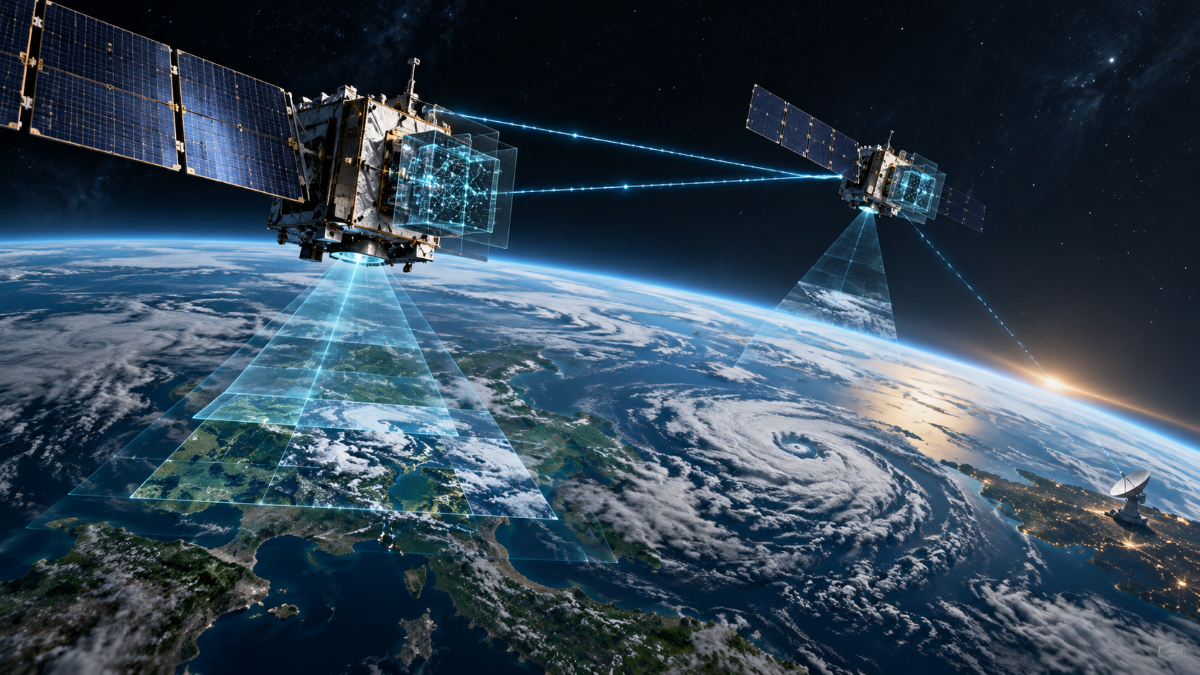
At an information day held at ESA-ESRIN on September 29, the agency outlined EOCognitiveLab, an open constellation concept built around a core two-satellite segment. The planned system is intended to combine onboard computing, artificial intelligence, inter-satellite communication and coordinated observations.
What ESA Is Building
EOCognitiveLab builds on ESA’s earlier Φsat work and its Computing in Space for Earth Observation activities. According to ESA, the project is intended to demonstrate AI-enabled cooperation across multiple heterogeneous satellites rather than treating each spacecraft as an isolated sensor.
The baseline concept includes event-based acquisition replanning, coordinated observations, onboard processing and exchange of information between satellites. ESA says the project will also develop the mission-orchestration framework needed to coordinate those functions.
AI Is Already Being Tested in Orbit
The concept is not starting from zero. Earlier in 2026, researchers successfully demonstrated NASA and IBM’s open-source Prithvi geospatial foundation model on two in-orbit platforms. NASA described that deployment as the first time a geospatial foundation model had been demonstrated in orbit.
NASA is also preparing the R5-S9 CubeSat to test edge-computing technology for autonomous observation of phenomena on Earth and in space. Together, these projects show a broader shift toward processing more information near the sensor rather than relying exclusively on ground-based analysis.
Verified Source Evidence
ESA’s September 29 EOCognitiveLab materials describe a cooperative two-satellite core, onboard computing, inter-satellite links and AI-enabled coordinated Earth-observation capabilities. NASA separately documents the Prithvi in-orbit demonstration and the R5-S9 edge-computing experiment.
EOCognitiveLab is an open constellation concept built around a core two-satellite segment that is expandable via federation of additional space and ground assets.