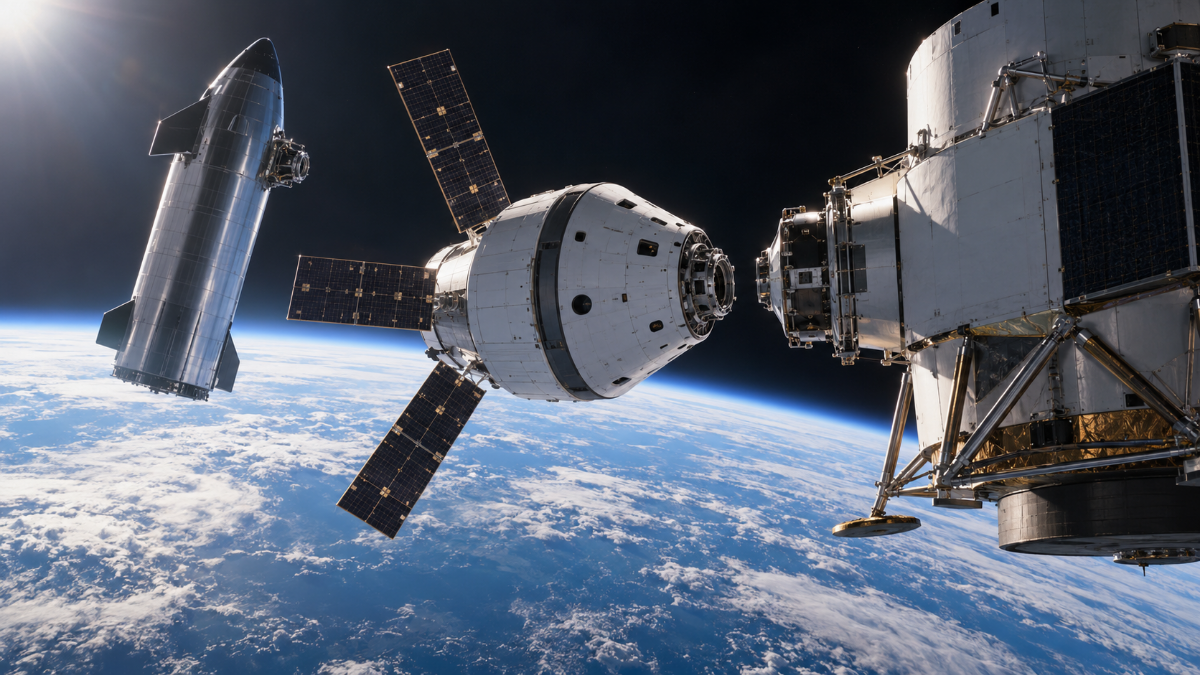
NASA plans to conduct one of the most complex test missions in its history to prepare for future crewed lunar landings. The primary objective is to perform a series of demonstrations with test versions of human landing systems developed by industry partners Blue Origin and SpaceX.
Bottom Line
Artemis III serves as a high-stakes rehearsal, using Earth orbit to test how Orion interfaces with two distinct commercial lander designs before astronauts attempt a landing on the Moon’s surface.
Testing Commercial Lunar Systems
The mission is designed to reduce risk and validate hardware before NASA attempts a crewed lunar landing in 2028. During the planned 14-day mission, crews and flight controllers will practice rendezvous, docking, habitation, and operational procedures. This experience is intended to provide the foundation for when Artemis astronauts begin landing near the Moon’s South Pole.
The mission involves three separate spacecraft launched on three different heavy-lift rockets within a short period. The first phase involves Blue Origin launching a test version of its Blue Moon Mark 2 lander into a circular low Earth orbit approximately 273 miles above Earth. This spacecraft can remain in orbit for up to 30 days, providing schedule flexibility for the subsequent phases.
Orbital Maneuvers and Docking Procedures
NASA plans to launch Orion on top of the Space Launch System (SLS) from Kennedy Space Center only days after the Blue Moon test article is confirmed healthy. Orion will initially enter an elliptical orbit before performing maneuvers to transition to a circular orbit at about 345 miles for thermal stabilization. Because each spacecraft operates in different orbital regimes, the mission requires a carefully choreographed sequence of maneuvers to achieve rendezvous.
During the first two days of flight, the crew will check out Orion’s systems and prepare for the first major objective: docking with the Blue Moon test vehicle. Once docked, astronauts will spend approximately two days conducting evaluations aboard the Blue Moon test article. Crew members will enter the spacecraft to assess the cabin environment, controls, and life-support systems firsthand. This provides the first opportunity to evaluate how many of the lander’s flight systems perform in space as an integrated vehicle.
SpaceX Integration and Science Objectives
After undocking from the Blue Moon lander, Orion will reposition to support a second rendezvous with a SpaceX Starship Version 3 test article. Because Starship has a shorter on-orbit lifetime than the Blue Moon lander, its launch occurs later in the mission sequence. Starship will enter a lower orbit at 206 nautical miles and carry an added docking system at its forward end.
Orion will dock with Starship for a test expected to last up to two hours. Unlike the Blue Moon test, crew members will not enter the Starship during this specific demonstration. The focus is on validating spacecraft controllability, communications, integrated software performance, and the dynamics of docking and undocking using different geometries.
Following these docking campaigns, Orion and its crew will have up to five additional days in orbit. NASA plans to use this time for various test objectives, including evaluations of Orion Crew Survival System suits, docking sensor tests, and acoustic and thermal measurements.
Verified Source Evidence
Before astronauts return to the lunar surface, NASA will first conduct one of the most ambitious and complex test missions in the agency’s history.
Source: NASA — NASA’s Artemis III Mission to Test Future Moon Lander Operations.
Source Licensing
- Source policy: NASA-MEDIA-USAGE-GUIDELINES (https://www.nasa.gov/nasa-brand-center/images-and-media/). NASA source material was used. The generated output is not attributed to the source organization. AI product attribution: Aurora AI. NASA review or permission is not implied.
Sources
1 independent organization · 1 source document. Links open the original material.